

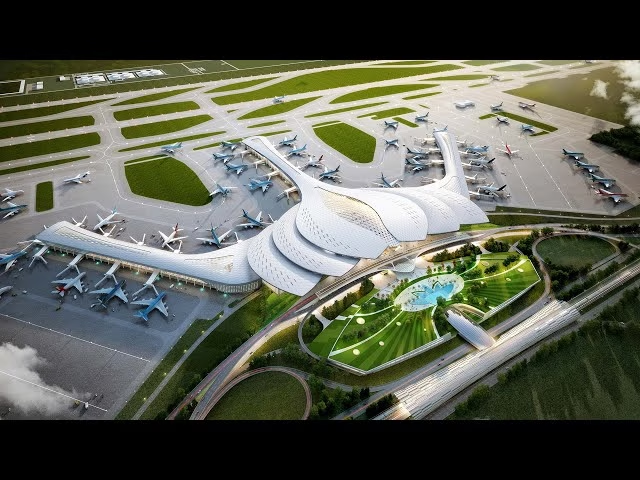
Long Thành International Airport is basically the south’s big “capacity reset”: a purpose-built, oversized hub out in Đồng Nai (about 40 km east of central Ho Chi Minh City) meant to do what Tân Sơn Nhất simply can’t anymore—keep expanding in line with demand and still meet modern hub standards. It’s a greenfield project owned by the Government of Vietnam, with Airports Corporation of Vietnam (ACV) as the main developer and operator. In early January 2026, the Ministry of Construction officially confirmed ACV as the investor/project owner for Phase 2, which further cements ACV’s central role beyond the first phase.
On the money side, the numbers fluctuate because people are often discussing different pieces of the puzzle—Phase 1 versus the full build-out, or just the airport core versus surrounding and ancillary projects. But the direction is clear: this is a multi-phase, multi-billion-dollar megaproject. Phase 1 is typically quoted at around US$4.6–5.4 billion, designed for about 25 million passengers a year and roughly 1.2 million tonnes of cargo, with one main passenger terminal and at least one long runway built to widebody/ICAO 4F standards. For the full master plan, you’ll often see “over US$16 billion” mentioned (across three phases in many official-style summaries). In comparison, other reports put the total closer to US$13+ billion, usually because they’re using a different scope or a specific VND total. In terms of timing, it’s best to think of it as: target commercial opening in 2026, with expansions staged afterward. Outlets such as VietnamPlus and VnExpress regularly describe Phase 1 as racing toward commercial operations by mid-2026, following a ceremonial or technical milestone at the end of 2025.
Why build a new international airport at all when Tân Sơn Nhất is already there? Because Tân Sơn Nhất has been stretched past its designed capacity for years. Various analyses note it was built for around 25 million passengers per year, but has handled well over that—mid-30 million in some years—and dense urban neighborhoods constrain it. That makes big runway or terminal expansions incredibly constrained, expensive, and politically sensitive. Long Thành is Vietnam’s choice to build a “second engine” instead of endlessly patching an overworked first one.
And Long Thành isn’t just “a new terminal.” It’s an ecosystem play. The plan is for a full hub-grade complex: passenger terminal(s), long runways capable of handling large aircraft, plus a freight and logistics layer designed to scale into an air-cargo hub with bonded warehousing, cold chain, express shipments, and cross-border e-commerce support. The logic is as industrial as it is tourism-focused: air cargo and fast connections can turn surrounding provinces into higher-value manufacturing and export bases. Đồng Nai sits right next to Bình Dương’s industrial zones and the wider southern production belt, so the airport is basically infrastructure that raises the ceiling for the whole supply chain.
All that said, there are real friction points—and glossing over them doesn’t help anyone.
First, access and connectivity. For people in inner Saigon—especially in the western districts—a 40 km airport is not “nearby” if the last-mile links are clogged or incomplete. That’s why you see so much attention on bus services, expressway connections, and PPP-type metro ideas like the Thủ Thiêm–Long Thành line concept. If those surface connections lag, you end up with the worst combination: the old airport stays overloaded, while the new one feels “too far” in actual and perceived travel time.
Second, environmental and community impacts. Dust pollution around the construction site has repeatedly been flagged as serious, with inspections and media coverage reporting that levels exceeded permitted thresholds and were affecting residents’ health and daily lives. It’s a classic megaproject side effect when speed outruns mitigation. On top of that, the resettlement burden is heavy—thousands of households impacted over the life of the project—which is where the social costs of a “national flagship” really show up.
Third, capital intensity and financing pressure. A project like this can be strategically sound yet financially burdensome. The spending is front-loaded: enormous capex up front, with payback that depends on how much traffic comes through, how strong commercial revenues are, and whether airlines actually build hub operations. Vietnam has used a mixed funding model over time: state budget funding for some components, ACV-led investment for core works, plus credit lines and potentially other sources tied to specific subprojects.
Then there’s the geography of “who benefits,” which is exactly where Long Thành gets interesting. For travelers from miền Tây, the downside is pretty clear: compared to Tân Sơn Nhất, Long Thành can mean extra surface travel time unless ring roads and expressways really work in their favor. That’s a political reality—where you put an airport always creates winners and losers in terms of travel-time geometry. For Vũng Tàu/Bà Rịa–Vũng Tàu and the port–industrial belt around Cái Mép–Thị Vải, and for trips naturally heading east or northeast (Đồng Nai, Bình Dương, onward to the central coast), Long Thành can actually be quite convenient once the expressway network is fully in place. For tourism flows, “convenient” isn’t just about residents; it also applies to tour operators and airline schedulers. A hub designed for growth lets Vietnam add slots, routes, and package-tour capacity without being choked by a maxed-out city airport.
That ties into why Vietnam is doing this now: the country is scaling both tourism and investment-led manufacturing, and both drive traffic. Reuters reported record foreign tourist arrivals in 2025—about 21 million—with China and South Korea as the top source markets, followed by Taiwan, the U.S., and Japan. Russia also bounced back strongly as a source of tourists in 2025 (around 690,000 arrivals, nearly triple year-on-year in some reports), which is part of why southern beach destinations and related flight networks are back in focus. On the investment side, Vietnam’s FDI story is still led by Asian capital: summary data repeatedly shows Singapore and South Korea among the top investors, with China and Japan also major players. That aligns with your strong Korean and Japanese expertise and supply chain presence, even if the actual number of foreign specialists on the ground fluctuates with project cycles and work-permit rules.
On jobs, there are really two phases: construction and operations. During peak build-out, reports have mentioned mobilizing around 14,000 construction workers plus thousands of machines to stay on schedule. For long-term operations, provincial and local reporting has talked about labor demand in the thousands to tens of thousands when you count ACV’s staff, airlines, ground handling, retail, logistics, and all the airport-adjacent sectors—industrial parks, warehouses, catering, maintenance, and so on. A fair way to put it is: the airport itself will employ a lot of people, but the real job engine is the cluster that grows around it, if—and this is a big if—the cargo, logistics, and industrial linkages actually scale as planned.
Will it “pay back,” and how long would that take? If you look at it like a CFO, big airports generally don’t “pay back quickly” in a straightforward, household-budget sense. Governments build them as multi-decade infrastructure platforms. Direct revenue streams—such as aeronautical fees, passenger service charges, landing and parking, retail and F&B concessions, advertising, real estate, and cargo handling—can be strong. Still, the initial capex is high, and the ramp-up is gradual. The strategic payback often comes earlier than the financial one: easing bottlenecks at Tân Sơn Nhất, allowing more routes and slots, and pulling higher-value logistics into the southern corridor can boost tourism income, export speed, and industrial competitiveness in ways that don’t fully show up on ACV’s own P&L. The project only really looks brilliant if three things line up: surface connectivity actually works, environmental and social issues are handled well enough to avoid serious backlash, and Vietnam succeeds in turning traffic growth into real hub economics instead of just “more passengers passing through.”
Compared to regional peers like Singapore Changi, Bangkok Suvarnabhumi, or Seoul Incheon, Vietnam is essentially making a hub bid—not by copying them exactly, but by building the basic physical platform needed to chase transfer traffic, widebody operations, and higher-value cargo chains. The downside risk is overbuilding ahead of proper coordination. The upside is unlocking growththat the old urban airport literally can’t handle. Long Thành is Vietnam’s way of moving the bottleneck outward—away from a boxed-in city airport—so the south can keep compounding tourism and industrial investment without slamming into a hard ceiling. In that sense, your instinct is right: this isn’t just an airport—it’s an economic geography project.
[ Membership ]