

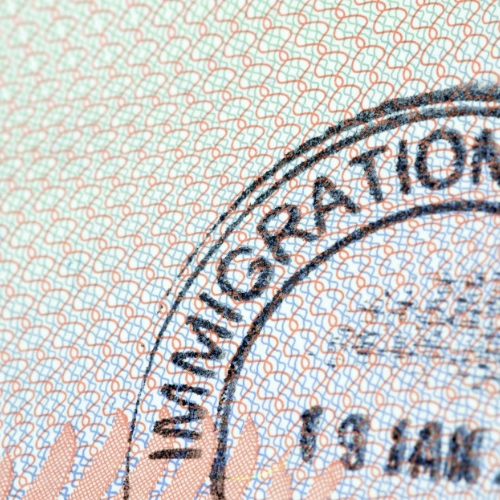
Across advanced economies—from Japan and Finland to the United States and much of Northern Europe—immigration policy is drifting in a strange direction. Governments openly admit they face severe labor shortages, especially in care work, healthcare, logistics, education, hospitality, and other people-centered sectors. Yet at the same time, they tighten entry rules, speed up deportations, shorten residence permits, and add administrative hurdles that cut precisely the population they need to keep their economies running. This isn’t mainly about ideology. It’s built into current policy structures, and the long-term economic cost is grossly underestimated.
Modern developed economies aren’t short of capital or technology. They’re short of people who are both willing and able to do work that can’t really be automated. Elder care, childcare, nursing, rehabilitation, teaching, supervising transport, maintenance, hospitality, retail, and a long list of support roles still depend on the presence of actual humans. When immigration is cut broadly, the immediate political optics may look good, but the second-order effects spread across the whole domestic economy.
Language education shows this clearly. Almost no one spends years learning Finnish, Japanese, Swedish, Norwegian, or Danish without a direct reason. Immigration creates that reason. When people arrive, schools open language programs, teachers get hired, curricula expand, and public education budgets can be justified by real demand. Remove immigrants, and demand collapses. Native-language teachers don’t appear out of nowhere or keep their jobs “just in case.” Programs shrink, funding dries up, and the broader language ecosystem weakens. This affects not just public integration courses but also private schools, testing systems, publishers, translators, and cultural institutions that depend on language learning.
The same dynamic runs through the service economy. Immigration increases population density, which keeps services alive. Hair salons, nail studios, gyms, cinemas, cafés, ethnic and local restaurants, tailoring shops, cleaning services, public transport usage, and small neighborhood shops—all of them rely on steady foot traffic. When immigration is sharply reduced, these sectors don’t glide into a smooth adjustment; they contract fast. Businesses close, people lose jobs, and tax revenue drops. Governments often blame this on “consumer pessimism” or vague “global conditions,” when a big part of the story is demographic policy.
Consumption goes well beyond the most visible services. Immigrants buy clothes, food, medicines, electronics, and basic household items. They rent or buy housing, pay utility bills, purchase insurance, and use cars, trains, and buses. Even low-income migrants contribute day in, day out to VAT-based systems simply by being in the economy. In aging societies like Japan and Finland, this kind of everyday consumption isn’t a bonus; it’s what helps stabilize internal demand when low birth rates can’t.
Logistics and transport form another piece that’s easy to miss. Immigrant communities generate cross-border activity, including remittances, cargo shipments, imports of food and goods, personal travel, and regular international flights to visit family. That demand keeps airlines, freight companies, ports, postal services, and last‑mile delivery networks busy enough to function efficiently. Remove a large share of immigrants, and volumes fall. Planes fly with more empty seats, cargo routes become marginal, and logistics costs creep up for everyone else. Once throughput drops below certain levels, economies of scale begin to erode.
None of this means there isn’t a real problem to address. Crime, exploitation of welfare systems, and communities that remain chronically outside the social and economic mainstream do exist. But economic thinking requires precision rather than blunt tools. Treating all immigrants as if they were one uniform group is lazy analysis and bad fiscal policy. High-skill workers, students, caregivers, entrepreneurs, and motivated job seekers don’t impose the exact costs—or generate the same benefits—as criminal networks or entrenched welfare dependency. When policy treats these groups as interchangeable, it produces failure.
A sensible immigration system doesn’t imply open borders. It implies selective retention. Screen effectively for criminal behavior, require real participation, cut benefits when integration is deliberately refused, and put resources into education and training where there’s clear potential. In every society, value is distributed unevenly. Even under challenging settings, some people are productive and want to contribute. Strong states learn how to retain and channel that value; weak ones let it slip away.
The greater danger of broad, sustained tightening is not just social tension. It’s economic hollowing. When working-age populations shrink faster than productivity can rise, the tax base erodes, pension systems come under mounting pressure, healthcare systems strain, and political debates become more defensive and zero-sum. Japan is already living with this reality. Finland is moving in that direction. The United States constantly argues over it, but often incoherently. Northern Europe risks drifting down the same path while assuming it’s somehow exempt.
Immigration isn’t a charitable project. It’s part of a country’s core infrastructure. Managed intelligently, it supports demand, labor supply, education systems, local services, logistics networks, and the fiscal balance. Managed poorly—or rejected in bulk—it accelerates demographic decline and slowly dismantles the everyday economy that citizens assume will always be there. The real choice isn’t between openness and security. It’s between targeted, intelligent filtering and self-inflicted economic damage.
[ Membership ]