
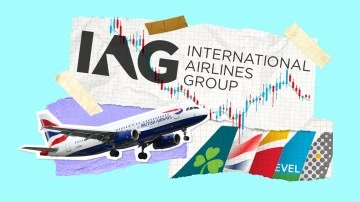
Airline investors typically assess performance using metrics such as load factors, route profitability, fuel hedging, labor costs, and network optimization. By these measures, Iberia, as part of International Airlines Group (IAG), appears stable. Post-pandemic restructuring improved balance sheets, demand has recovered, passenger volumes are nearly restored, and capacity discipline has supported margins on European and transatlantic routes.
However, aviation often demonstrates that financial recovery and customer confidence do not always align.
Iberia now presents a case where reputational risk may be increasing despite acceptable operating metrics.
Unlike manufacturers or infrastructure operators, airlines primarily sell an experience based on trust. Customers pay in advance, relinquish control of their schedules, and depend on complex, unseen systems. This relationship is not solely about price; it relies significantly on passengers’ confidence that the airline will support them when issues arise.
This is where warning signs are emerging.
Reviews on platforms such as Trustpilot and Google highlight not only delays, which are often unavoidable, but also the airline’s response to disruptions. Common themes include difficulty obtaining clear information, inconsistent communication, unresolved issues, and a perception that customer experience is deprioritized during disruptions.
A single online complaint may be insignificant. However, persistent low ratings across substantial volumes of feedback suggest a structural issue: declining confidence in the airline’s response to service failures.
Consumers now consider review platforms integral to their decision-making. Trustpilot scores, Google ratings, and social media feedback are evaluated alongside price comparison tools. In Europe’s competitive airline market, reputation can shift more rapidly than marketing efforts can address.
The financial impact of reputational risk is often underestimated.
Airline revenue relies on repeat customers and the goodwill that sustains a brand during disruptions. Passengers typically accept delays if they believe the airline is addressing the issue. However, when disruptions are accompanied by poor communication or perceived indifference, customers often choose alternative carriers, accept less direct routes, or book to minimize reliance on an airline they no longer trust.
This shift rarely appears immediately in quarterly results.
Instead, reputational damage typically emerges gradually through weaker pricing power, increased reliance on discounts, and reduced loyalty in higher-yield segments. Passenger numbers may remain stable, but margins can decline as customers become more price-sensitive and less brand-loyal.
For IAG investors, Iberia’s reputation extends beyond customer satisfaction scores. Within a group structure, uneven brand strength can create internal imbalances. Stronger brands may compensate for weaker ones, masking deterioration until competition increases or market conditions change.
When demand is strong, operational and service shortcomings are often overlooked. However, when market conditions shift, and passengers become more selective, airlines perceived as unreliable or indifferent typically experience sharper declines in demand than trusted competitors.
Unlike aircraft or slots, reputation cannot be refinanced or quickly rebuilt.
The increasing volume and visibility of negative passenger sentiment on public review platforms create an intangible liability that is rarely reflected in standard airline valuation models. Investors who focus primarily on financial recovery may underestimate how quickly consumer perception can affect long-term brand strength.
Ultimately, aviation depends more on confidence than on capacity.
Passengers do not expect perfection, but they do expect the airline to take responsibility when issues occur. When a significant number of customers feel their experience is not a priority, trust declines. In a discretionary sector such as air travel, loss of trust is one of the few risks that can undermine an otherwise operationally sound business.
Iberia’s challenge is not maintaining operations, but protecting and rebuilding its reputation.
For investors, the key question shifts from whether the airline can fill seats today to whether passengers will continue to choose it in the future, given abundant alternatives and minimal switching costs.
In a market defined by transparency and collective consumer memory, reputational risk is no longer a secondary concern.
It is a financial risk.
[ Membership ]