
Singapore doesn’t pick between the Western New Year and the Lunar New Year. It takes both, tunes both, and folds both into a tightly managed national rhythm.
January 1st is a public holiday. Fireworks go up over Marina Bay. Hotels sell out. Rooftop bars run countdown parties timed to global financial centers from New York to London. The message isn’t subtle: Singapore sits firmly inside the international economic grid. The Gregorian calendar runs trade, reporting, fiscal years, and capital markets—Western New Year slots neatly into that whole setup.
Then, a few weeks later, the tempo changes.
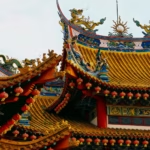
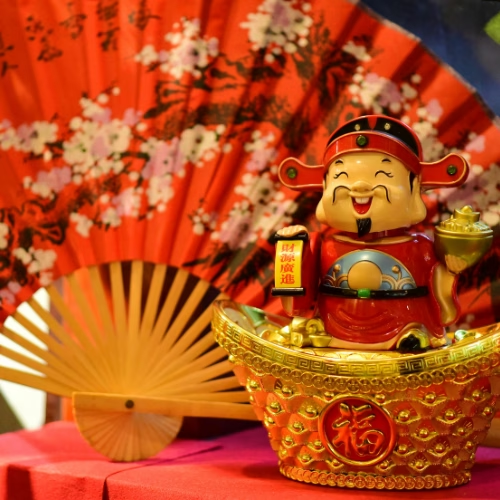
Lunar New Year—usually called Chinese New Year in Singapore—has a different kind of weight. With around three-quarters of the population ethnically Chinese, the festival isn’t decorative; it’s foundational. The state grants two public holidays. Chinatown turns red and gold. Families gather. Red packets move from hand to hand. Reunion dinners take over the calendar. The ritual of lo hei—the tossing of raw fish salad while calling out wishes for prosperity—captures that mix of inherited tradition and modern commercial drive.
What sets Singapore apart from Vietnam, China, or even parts of Malaysia isn’t that it celebrates. It’s how it manages the disruption.
Vietnam slows almost to a standstill during Tet. Factories shut.—logisticsstall. Government offices close for days. Travel networks are pushed to the limit by domestic migration. The country accepts a temporary economic slowdown as the cultural cost of renewal.
Singapore doesn’t.
Ports keep running. Financial institutions keep minimal but functioning operations. Supply chains prepare for a dip but don’t buckle. The holiday is real, but the infrastructure holds. There’s no nationwide economic freeze. The system is built to accommodate cultural celebrations without compromising operational continuity.
This balance between the two calendars rests on some deeper structural realities.
First, Singapore is a global financial hub with an outward-facing economy. Any long shutdown would send immediate ripples through trade, shipping, and capital flows. Its small size also helps: families are usually only a short drive or train ride apart. There’s no equivalent of the huge rural-urban migration you see in Vietnam during Tet.
Second, Singapore’s governance model emphasizes efficiency. Holidays are respected, but within clear and predictable limits. The state formalizes celebration, but doesn’t let it destabilize productivity.
Third, multicultural balance shapes the calendar. Singapore isn’t only Chinese. Malay and Indian communities mark their own major festivals—Hari Raya and Deepavali—which are also public holidays. The year becomes a revolving framework of cultural recognition. No single festival dominates the entire national schedule.
What emerges is a kind of hybrid.
On December 31st, Singapore locks in with global capitalism. On Lunar New Year, it taps into an older civilizational lineage. In between, imaintainsps its economic rhythm.
Something is telling in that setup. Singapore shows that modernization doesn’t have to erase culture. And tradition doesn’t automatically require the whole system to shut down. The city-state leans toward integration instead of replacement—and that seems to be the more durable approach.
Vietnam offers emotional intensity and a shared, deep pause. Singapore offersa measured celebration built into continuity.
Both approaches have their own logic. One leans into cyclical cultural immersion; the other leans into structural stability. In a world wired by just-in-time supply chains, Singapore’s model reduces friction with Europe and North America, where production rarely pauses across the board for lunar festivals.
Yet the celebrations in Singapore are still real. During Lunar New Year, malls are packed, gift hampers move around offices and homes, and families carry out their rituals with full sincerity. The distinction isn’t in how people feel—it’s in how long everything slows down and how far into the system that slowdown reaches.
Singapore doesn’t walk away from either calendar. It lines them up.
In doing that, it mirrors its broader identity: a port city rooted in Asia, running on global time, strict in structure, yet loose enough in culture to bend without breaking.
Two new years. One uninterrupted economy.
[ Membership ]