

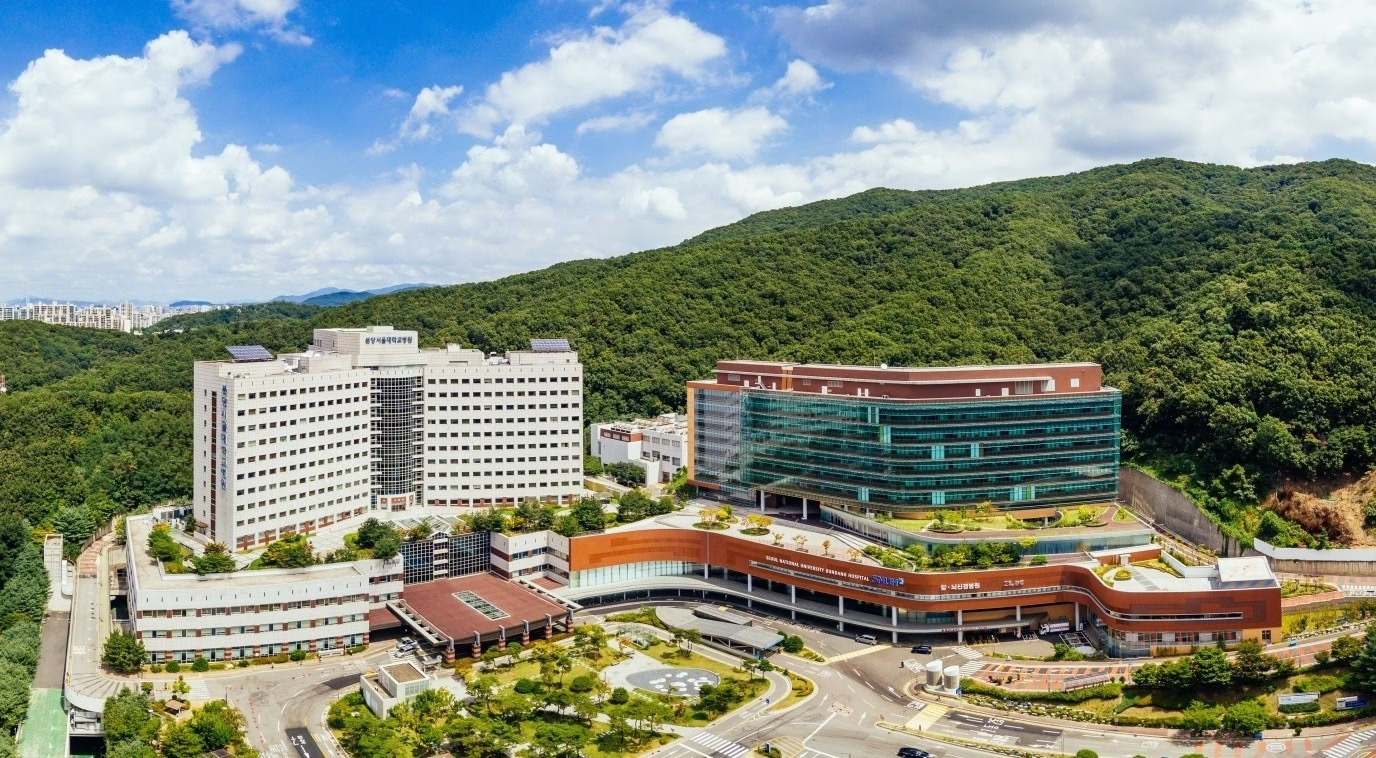
When people talk about economics and business education in South Korea, Seoul National University almost automatically comes up—not because it’s busy selling itself with flashy international marketing, but because it’s long served as the country’s intellectual backbone for economic thought and policy.
What really sets SNU apart is the way it has shaped Korea’s thinking about growth, crisis, and integration into the global economy. A large share of the economists, regulators, and top executives who helped steer the country through rapid industrialization, the Asian Financial Crisis, and the shift into a high-tech, export-led economy studied here. That history shows up in the classroom. Economics at SNU is taught with a strong sense of continuity and institutional awareness. Students don’t just learn models and equations; they’re pushed to see how culture, governance, and corporate structures connect to actual economic outcomes.
The academic culture is demanding and, in the best way, intellectually conservative. The core training in microeconomics, macroeconomics, and econometrics is rigorous, heavily mathematical, and data-driven. Classes at SNU emphasize a balanced mix of traditional lectures, dynamic discussions, and project-based learning. Lectures provide the theoretical framework, which is then explored in depth through discussions. These discussions encourage students to critically engage with the material, while project-oriented tasks allow them to apply theoretical concepts to real-world scenarios. There isn’t much patience for vague claims or hand-waving. Students are expected to argue clearly, back up their points with evidence, and be honest about what a given analytical framework can and can’t explain. The result is graduates who may not be the loudest voices in the room, but who can do serious economic analysis.
In addition to core economics, SNU offers solid options in finance, accounting, management, international business, and business analytics through its business school, and in public economics, development economics, labor economics, and international trade within the economics department. At the graduate level, tracks in applied economics, financial economics, and policy-focused research are exceptionally well regarded. These aren’t abstract offerings; they closely mirror Korea’s real economic priorities—export performance, industrial policy, demographic challenges, technological upgrading, and financial stability.
Studying economics at SNU also means being right in the middle of Seoul, one of Asia’s most active economic hubs. The city brings together global conglomerates, financial institutions, startups, regulators, and research centers. That proximity isn’t just a lovely backdrop; it shapes how students learn. Internships, policy forums, corporate case work, and guest lectures become a natural extension of classes. Students have the opportunity to intern with major firms such as Samsung, Hyundai, and LG, attend policy forums hosted by the Bank of Korea, and participate in corporate case projects with leading consultancy firms. This direct interaction allows them to see how decisions are made in firms and ministries, not just how they’re described in theory.
After graduation, career paths tend to reflect this focus on substance rather than image. Many alums move into government ministries, the central bank, major conglomerates, consulting firms, financial institutions, and international organizations. Notable alumni include former Finance Minister Kim Dong-yeon and Kwon Oh-joon, former CEO of POSCO, which highlights the caliber of professionals emerging from SNU. Moreover, recent placement statistics are encouraging, with 85% of graduates securing positions within six months of graduation. For those looking beyond Korea, an SNU degree, especially a graduate degree, is well recognized across East Asia and is increasingly noticed in Europe and North America, particularly for roles in economics, policy work, and research.
The environment at SNU isn’t comfortable in the easy sense. Competition is intense, standards are high, and the culture leans toward discipline rather than convenience. However, SNU offers a range of support systems to ensure students thrive, including comprehensive academic advising, accessible mental health resources, and a strong peer support network. For students who care more about depth, credibility, and building long-term intellectual capital than about quick branding, that’s precisely the appeal.
In the end, Seoul National University is a place worth studying economics, not because it offers quick wins, but because it brings together something rare: tough analytical training, a deep sense of history and institutions, and direct exposure to one of Asia’s most critical economic systems.