

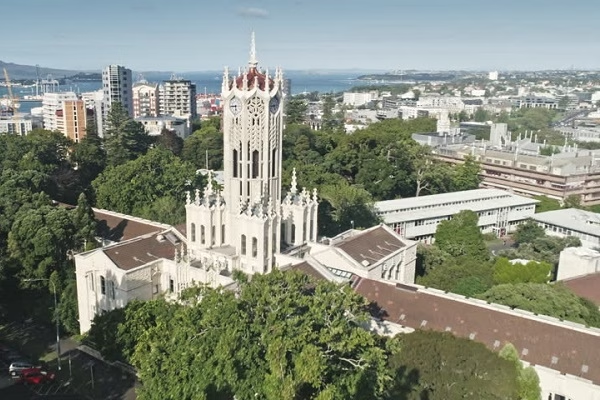
When people talk about studying economics or business in New Zealand, the University of Auckland almost always comes up. It doesn’t boast, but its results speak for themselves, quietly and consistently.
One reason Auckland stands out is its location. It’s in the country’s largest city, close to the institutions that shape the economy, like banks, regulators, consulting firms, tech companies, exporters, and government agencies. That closeness matters. Economics isn’t treated as something abstract or distant. It’s taught as something connected to real policy decisions, labor markets, trade, housing cycles, and Asia–Pacific issues. Imagine students leaving a dynamic lecture on macroeconomic policy and taking a short walk through a bustling street lined with cafes and tech startups to reach a nearby fintech lab, where they attend workshops held by leading industry professionals. This proximity allows students to quickly see where theory works and where it doesn’t when put into practice.
Academically, the economics and business programs are known for being rigorous and relevant. The core subjects, like microeconomics, macroeconomics, and econometrics, are strong, but the focus goes beyond just passing exams. Students are encouraged to use these tools to tackle important issues such as inequality, climate policy, migration, and financial stability. For instance, the university hosts a signature capstone project, where students collaborate with local government agencies to address real-world challenges in climate policy. This hands-on experience allows students to apply theoretical knowledge to practical problems, demonstrating the university’s commitment to impactful education. The approach is analytical, not ideological. You’re expected to argue clearly, use data well, and understand trade-offs, rather than just follow trends.
Research is another strength at Auckland. The university consistently ranks at the top in New Zealand for research output, and this work is shared in the classroom. For example, just last week, Professor Emma Lee presented her groundbreaking study on sustainable finance during a seminar, sparking a lively discussion among students and faculty. Her research, focusing on new financial models to support green initiatives, directly influenced the subsequent class debate on climate policy. Many lecturers are involved in policy advisory work or international research networks, so course content often reflects current debates instead of old material. For those considering postgraduate study, honours, master’s, and PhD programs are well organized and recognized overseas.
Students often focus on areas like economics and finance, international business, accounting, commercial law, information systems, and operations and supply chain management. At the postgraduate level, applied economics, finance, business analytics, and management are especially strong. These programs are designed to be genuinely useful across different industries and countries, not just for marketing.
What happens after graduation? While there are no guarantees, a degree from Auckland carries credibility. It is well recognized in Australia, much of Asia, and increasingly in Europe and North America. Graduates often work in banking, consulting, government policy, multinational companies, or Asia–Pacific hubs. Some use the degree to continue their studies overseas. The alumni network in New Zealand is practical and trusted, with people knowing the standard of training.
The university isn’t perfect, and it doesn’t claim to be. Class sizes can be large, and the atmosphere is often competitive. Students looking for lots of support or a purely job-focused approach may find it challenging. But for those who want a demanding education that values theory and keeps it grounded in real data and economic conditions, it remains the standard in New Zealand.
The University of Auckland is worth considering, not because it promises instant change, but because it offers something harder to find: a solid, internationally recognized economics education that helps you think clearly in a complex world.