

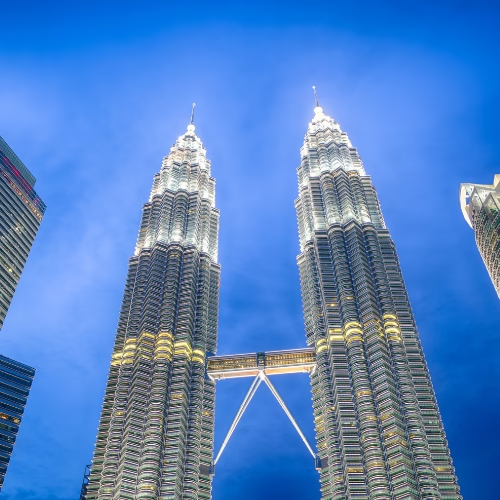
Malaysia doesn’t often make global economic headlines. It lacks Singapore’s reputation for efficiency, Indonesia’s size, or Vietnam’s manufacturing strength. Still, for decades, Malaysia has achieved something more difficult: a stable, steadily growing economy that can handle shocks and adapt without major disruption. Its prosperity isn’t just luck or the result of one big reform or a sudden resource boom. Instead, Malaysia’s strength comes from the steady and consistent way it has developed over time.
Much of Malaysia’s stability comes from its place in global supply chains. Rather than rushing into advanced innovation or relying only on cheap labor, Malaysia found a middle ground in the industrial value chain. It has become a reliable base for electronics, semiconductors, precision parts, and industrial assembly, especially for multinational companies wanting to expand in Asia. This role may not attract much attention, but it brings steady export income, stable jobs, and strong ties to global trade.
Natural resources have played a role, but Malaysia has managed them more carefully than many other countries. While it has oil and gas, Malaysia has not become fully dependent on them. The state-owned company Petronas has served as more than just a source of money; it has helped keep the economy stable over time. Oil and gas income has funded public projects, built infrastructure, and created financial reserves, staying mostly separate from daily political issues. This discipline has helped Malaysia avoid the common ‘resource curse’ that has hurt other countries.
Geography has also helped Malaysia. Located along the Strait of Malacca, one of the world’s busiest shipping routes, Malaysia has used its location to its advantage. It built ports, free trade zones, and industrial areas, focusing on moving goods efficiently instead of building for show. This means Malaysia earns money not only from its own products but also by supporting global trade. This role helps keep the economy steady, even when the world economy slows down. Trade may decrease, but it rarely stops completely.
Malaysia’s financial system has made the economy even stronger. The country created a top Islamic finance center, attracting money from the Middle East and other Muslim-majority countries, while also keeping a full conventional banking system. This mix gave Malaysia more funding options, reduced risks from speculation, and encouraged careful lending. As a result, Malaysia’s financial sector has mostly avoided the big ups and downs seen in more open markets.
Politics has played a role too, despite its problems. Malaysia’s government has sometimes been inconsistent and contentious, but its institutions have mostly stayed strong. Changes in leadership did not cause major disruptions, and economic policies rarely shifted drastically. For investors, this predictability is often more important than perfect policies. Malaysia has offered enough stability, clear laws, and capable administration to support long-term planning, even during political uncertainty.
Society has also helped keep Malaysia stable. The country is multi-ethnic, and its social policies, like redistribution and affirmative action, have faced criticism for being inefficient or unfair. Still, these policies helped prevent serious social problems. Economic growth has been used to ease social tensions as well as to build wealth. This approach reduced the risk of major unrest, which often disrupts other developing countries at similar stages.
What matters most is what Malaysia decided not to do. It did not move too quickly into complex finance before its institutions were ready. It kept its industrial policies instead of switching fully to free-market ideas. It avoided big, showy projects that lacked a strong economic reason. Growth goals were realistic, reforms happened step by step, and policy changes were gradual, not sudden. This careful approach may have slowed short-term progress, but it helped protect the country’s long-term stability.
Malaysia’s prosperity is not about a sudden rise, but about steady balance over time. It is built on realistic goals, different sources of income, patient institutions, and a clear understanding of its role in the world. While many countries chase quick results and attention, Malaysia shows that lasting economic success often comes from staying steady where global trade and investment meet.
[ Membership ]