

Finland’s housing market heading into 2025 and the start of 2026 has been going through something pretty typical for the region. It’s nothing like a crash; more of a drawn-out deflation from the high energy of 2021 and 2022. If you’re thinking about investing, one thing you really need to get is that Finland doesn’t have a single housing market—there are basically two. First, you’ve got the growing city areas, with Helsinki and its metro leading the way, and cities like Tampere and Turku right behind. These places see demand bounce back over time because of jobs, universities, and a steady stream of people moving in. Then there are the regions that are shrinking, where buyers dry up and prices can flatline for years.
If you’re just looking at national stats or tuning in to the usual market commentary, the general message isn’t, “Here comes a big boom”—it’s more like, “Things have steadied out, and 2026 could be a bit more normal.” Banks like Nordea have spelled this out, too: price growth is being held down because there are plenty of homes up for sale, and even in more optimistic scenarios, they only see mild upward movement after a slight dip.
On the rental side, things haven’t been so rosy either. It’s definitely not been a straight climb up—more like the market staying flat or even a little soft, and it really depends on the area. One big reason is oversupply: a lot of new rental apartments, especially small ones owned by investors, have hit the market. But demand hasn’t matched that everywhere, so landlords don’t have much leverage to raise rents. Nordea and others have basically said that rents will probably stay in check because of all the extra supply. There’s a little optimism that things might start to rebalance over 2026 to 2027—if new construction slows down and more of the population heads to the bigger cities. What that boils down to: the best areas will stabilize first, but if you’re not in a prime spot, you could be waiting a while or having to compete with tenant incentives and lower prices.
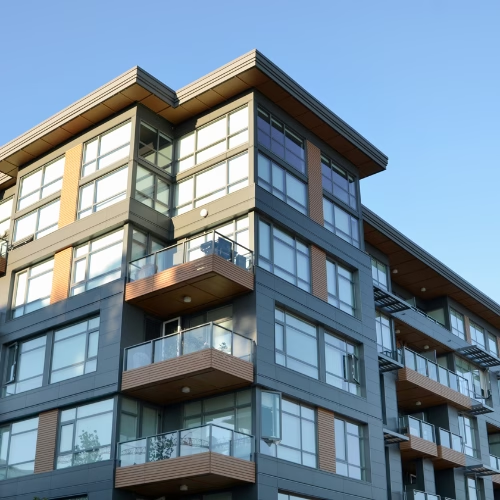
Here’s something that tends to confuse folks from outside Finland: “ownership” here doesn’t always work the way you might expect. It’s pretty rare to buy the actual land and walls as your personal property when it comes to apartments. What usually happens is you buy shares in a housing company (in Finnish, asunto-osakeyhtiö). Those shares give you the permanent right to live in (and resell) a certain apartment, so in practice, it feels like ownership. Legally, though, you own part of a company that owns the building (and sometimes the land). If you go for a detached house, then you’re likely dealing with a standard real estate purchase—building and land, all under your name.
Why does this matter? Well, when you’re from outside the EU or EEA and want to buy actual property—meaning land and a house—there’s a special permit you need to get. The Ministry of Defence oversees this, and InfoFinland does a nice job of explaining it: you’ll probably need a permit to buy a house or land, but you don’t need one if you’re buying shares in a housing company (which covers most apartments).
People sometimes ask about whether “forever ownership” exists in Finland. It absolutely does—you can privately own property here, and there’s no automatic expiry, just that permit you need if you’re from outside the EU/EEA. Even with apartment shares, your ownership is indefinite—there’s no time limit—but the structure is just a bit different, as it’s through a company. There’s one extra detail worth checking: does the housing company actually own the land, or are they leasing it (vuokratontti)? If it’s leased, your monthly bills can go up when the land rent is adjusted, which can affect both your cash flow and your future resale value. It sounds small, but it can make a real difference over the years.
Thinking of renting out your place? Finland’s straightforward, though you’re not likely to get rich quick. Rental income is taxed as capital income: 30%, and if your taxable income from capital sources gets above €30,000, the rate goes up to 34%. The upside is that taxes are only applied to your net income, not the full amount. So, you can deduct costs like housing-company charges, repairs, and pretty much any expense tied to generating that rental income. The downside? Finnish apartments can come with pretty hefty monthly maintenance fees, and sometimes the housing company will ask for extra payments if something big needs fixing (pipes, the façade, elevators, energy upgrades, that sort of thing). Sure, some of those costs are deductible, but they still eat into what you take home every month. Once you factor in maintenance, financing, vacant months, broker fees, repairs, and then that capital income tax—there’s not always a lot left at the end of the day. A lot of people find that “what you actually get in your pocket” is much lower than what those gross-yield calculators suggest.
So, is now a good time to buy with prices down? It can be, if you pick the right place, go in with realistic expectations, and play it smart. Lower prices and longer selling times mean you can negotiate and be choosy. It’s good to focus on three things: the specific location within the city (sometimes just a few blocks make a difference), the financials of the housing company (look for upcoming renovations, the company’s debt, land ownership), and how easy it will be to sell if you need to get your money out. Just be careful—sometimes something is “cheap” for a reason, and if it’s because the whole area is losing people, then you’re actually buying into a tough situation, not a bargain.
The big picture: Finland’s market is stable, with strong laws and transparent taxes. It really does reward patient folks who pay attention to the fundamentals, not people hoping for quick returns or who ignore things like maintenance fees and neighborhood trends.
[ Membership ]