

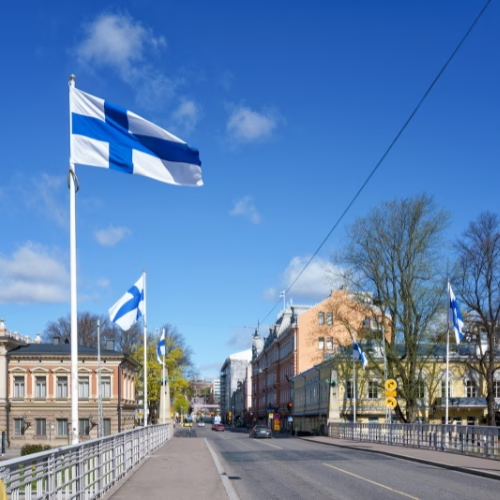
At first glance, Finland doesn’t seem like an attractive place to invest right now. Public debt has risen faster than most people expected. Unemployment is among the highest in the EU. Many skilled and mobile immigrants have already left. In addition, some U.S. and international investors are still cautious, pointing to geopolitical risks linked to Finland’s long eastern border with Russia.
But markets rarely reward investors who wait until everything feels safe and comfortable. Instead, they tend to favor those who understand cycles and are willing to act when pressure leads to change.
What looks like a structural weakness right now is actually increasing pressure on Finnish policymakers to be more practical. Governments rarely make big reforms during good times. They act when they have fewer options. That’s exactly where Finland is heading.
As the government’s budget gets tighter and fewer people are working, the state has less room to maneuver. It needs to work harder to attract private investment. This competition doesn’t have to involve big ideological debates. It usually means practical steps like more flexible tax rules, cheaper industrial land, faster permits, clearer regulatory timelines, and fewer administrative barriers for investors who want to build and create jobs. These aren’t just policy ideas—they’re the usual tools governments use when economic pressures increase.
You can already see similar strategies in other parts of Europe. Estonia, dealing with its own demographic and size issues, created e-Residency so entrepreneurs worldwide can run EU-based companies easily. Malta chose another path, linking foreign investment to residency and programs that support its economy. The details differ, but the main idea is the same: when growth slows, being open becomes an advantage.
Finland is in a strong position to benefit from a similar shift. Decades of industrial growth, especially during the Nokia years, left behind many factory sites, logistics centers, and industrial campuses. Many of these places are still in good shape, well-connected, and not fully used. For investors, this means lower upfront costs, faster setup, and the chance to grow without starting from zero. In today’s world, where speed and efficiency matter more than new buildings, having existing industrial capacity is an advantage.
Concerns about the eastern border make sense, but they are often exaggerated from an economic point of view. Finland is not a fragile or unprepared country. Its defense is strong, its alliances are clear, and its approach is defensive, not aggressive. For investors, there is no real economic reason or financial capacity for a major conflict in the region. Markets often confuse being near a risk with the risk actually happening. Just being close to a risk doesn’t make it likely.
In the long run, economic stability is usually supported by trade, not isolation. Finland’s strengths in food processing, dairy, clean manufacturing, and industrial materials have always been in demand in eastern markets. Politics shape policy, but geography remains. Over time, business sense tends to return, especially when both sides benefit.
For investors willing to look past the headlines, Finland today looks a lot like markets that are just on the edge of being re-priced. Asset values are lower. Labor is available. Infrastructure is already in place. Policymakers are being pushed to reduce complexity, not increase it. Public conversation may sound tense or pessimistic, but that kind of anxiety often shows up right before fundamental reforms begin.
This isn’t about quick trades or sudden recoveries. It’s about timing, patience, and knowing how small, tightly regulated economies react under pressure. When things look worst, incentives often start to improve quietly. When incentives change before public opinion does, the investors who notice are usually the first to benefit—well before optimism returns.
From this perspective, Finland’s current situation isn’t a warning sign. It’s a signal that rewards careful analysis over distractions, and long-term planning over waiting until everything appears safe.
[ Membership ]