

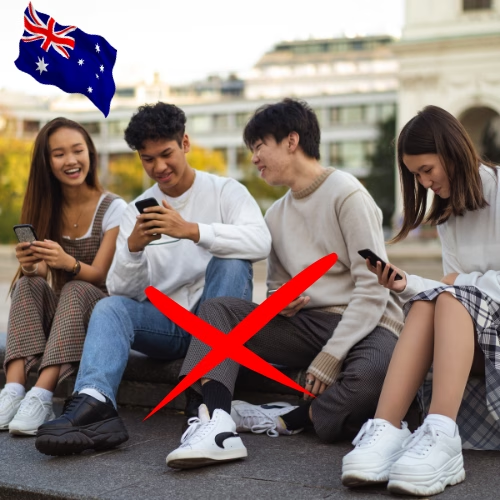
Australia’s under-16 social media crackdown is a rare example of a government recognizing the attention economy as a youth-risk product. These platforms make private profits while leaving mental health, safety, and policing costs for the public to handle. The main idea—keeping kids off social media until at least 16—makes sense both morally and economically. But the way it’s being carried out has a common problem: banning just “ten platforms” lets the market find ways around the rule. These apps are easy to rebrand and often belong to bigger companies that can quickly create new versions before regulators can respond.
Australia’s law begins by restricting access to a specific list of services like TikTok, Instagram, YouTube, Snapchat, Reddit, X, Twitch, and Threads, while leaving out others such as messaging apps and some game or social hybrids for now. This approach might make sense for practical and privacy reasons. It’s simpler to start with the major platforms instead of trying to regulate everything at once. However, this also creates a situation where blocking the main platforms just pushes users to less obvious alternatives.
This is the main problem with the “only ten” approach. When a group of platforms faces new rules, they don’t have to fight in court—they just need to keep users inside their own network. That leads to new apps, spinoffs, and networks that act as easy workarounds. Lemon8, for example, is closely linked to TikTok and comes from the same company. If the definition of “social media” is too narrow, the rules don’t really address the problem. Instead of tackling what causes harm—like addictive feeds, fast-spreading content, and easy access for strangers to contact minors—regulators end up just chasing after brand names.
This is why a stricter approach—banning all forms of social networking for minors, not just a select few—makes more sense. If the real aim is to protect kids, the rules should focus on what the platform does, not just its name. This includes things like public profiles, recommendation feeds, live streaming, discovery features, open messages from strangers, and any system designed to keep users engaged through endless scrolling and social comparison. By regulating features rather than brand names, it becomes much harder for companies to create new apps that circumvent the rules, since any similar platform would face the same restrictions.
Morally, the case is even stronger when we stop seeing these platforms as just “communication tools” and recognize them as systems designed to influence. They are built to guide, pressure, or even push vulnerable kids toward self-harm, risky behavior, eating disorders, or extremist content, often without parents or teachers noticing until it’s too late. The issue isn’t just that kids make poor choices. The real problem is that these platforms are designed to keep users online as long as possible, and children are especially unprepared to resist that kind of pressure every day.
From an economic perspective, this design shifts the costs to the public. It leads to overwhelmed school counselors, more mental health referrals for teens, sleep problems, shorter attention spans, and families under constant stress. Police and child protection teams also face more work dealing with grooming, sextortion, harassment, and other threats. There’s no need to create a moral panic to justify action. Governments already regulate products that can harm minors, and in this case, the risks are clear, widespread, and easy to spread across borders.
From a safety perspective, broad restrictions help reduce risks similar to “online kidnapping.” This doesn’t always mean physical abduction. It can involve offenders finding a target, gaining their trust, isolating them from family or friends, pressuring them to keep secrets, and then demanding images or money. Sometimes this leads to real-world meetings or long-term control. When platforms make it easy to find and manipulate minors, it lowers the barriers for offenders. Even if only a few children are directly affected, the overall burden on law enforcement and child protection is significant, and the personal harm is serious.
Australia does well by focusing on platform responsibility instead of blaming families. The law requires age-restricted services to take “reasonable steps” to keep under-16s off their platforms, and companies—not parents—face penalties if they fail. This approach makes sense economically because it puts pressure on those who create and profit from these systems. However, this raises a new challenge: if age checks become strict, how can privacy be protected and a surveillance system avoided?
The best solution is to require privacy-friendly age verification. This means using systems that check age without saving identity data, setting strict limits on what information is collected, and enforcing strong penalties for using age-check data for advertising, profiling, or anything else. Without these protections, solving one child-safety issue could create a bigger problem for civil liberties.
Looking ahead, there are a few signs to watch for. First, pay attention to leaders who talk about social media as a child-safety issue instead of a free-speech debate. Second, look for regulations that focus on age checks and platform responsibilities, since these are more likely to succeed against industry pushback than broad attacks on “big tech.”
France is already moving quickly in that direction, with Macron pushing an under-15 restriction on an accelerated path. That’s a strong hint that in parts of Europe, the Overton window has shifted from “ban phones in schools” to “ban accounts for kids.” Denmark is widely reported to be considering a ban-style approach around 2026, and Malaysia has flagged an under-16 ban starting in 2026 as well—both in line with the idea that Australia has provided a working template. Beyond that, India is the big “wait and see” case: national legislation is tricky, but you’re starting to see proposals and state-level interest that explicitly reference the Australian model.
Looking ahead, the next round of regulations probably won’t focus on banning a set list of apps. Regulators are learning that fixed lists are easy to get around, while platforms can adapt quickly. If the goal is to reduce teen suicide, grooming, coercion, and the decline in attention and thinking caused by engagement-driven feeds, then the focus needs to be on the entire category of algorithmic social networking for minors.
Countries with strong child-protection standards, centralized regulators, and a willingness to use public-health policies are most likely to act first—mainly in Europe, followed by some Asian countries. The economic logic is simple: if these rules reduce even part of the mental health and policing burden, they are worth it. As a bonus, they help kids enjoy a more grounded childhood, with real friendships and a healthier, slower pace of life.
- Why Setting Age Limits on Smartphones and Social Media Isn’t Overreacting—It’s Just Practical Policy
- Australia’s Health Tech Economy: Research-Led, Clinically Grounded, and Built for the Long Game
[ Membership ]