

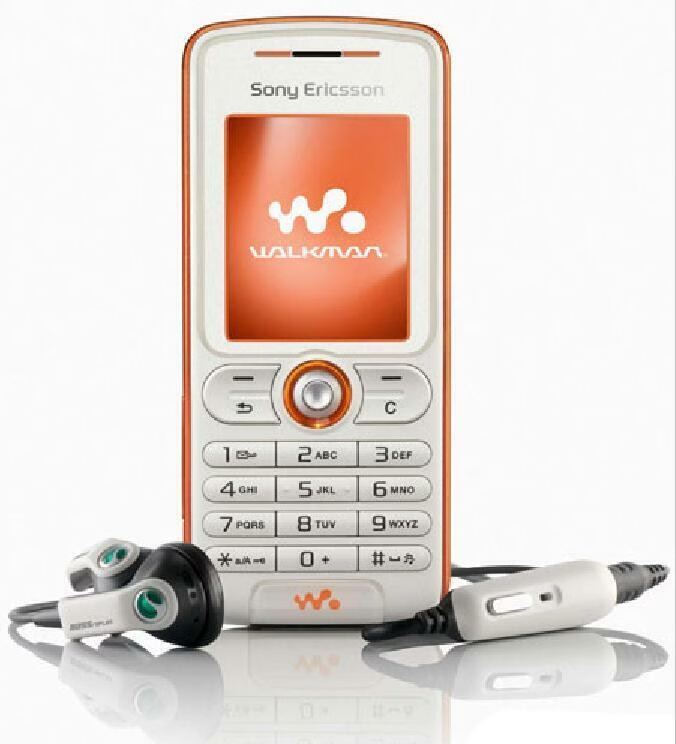
Ericsson—officially Telefonaktiebolaget LM Ericsson—is basically one of the last big “Western backbone” suppliers for mobile networks. In other words, they’re the folks making sure 4G and 5G (soon enough, probably 6G too) actually work behind the scenes: think radio access networks, core networks, the software that keeps it humming, and all the services operators need to build, run, and upgrade this complicated web. They’re also trying to get a piece of the pie in areas like enterprise and private networks, plus anything buzzwordy like “programmable networks” (read: automated, software-driven networks). Makes sense—the pure telecom hardware business is a wild ride, with massive rollouts followed by years of belt-tightening when operators stop spending.
The headline right now? Ericsson is cutting jobs again. The market actually liked the news, weird as that sounds, probably because the layoffs are happening while profits and shareholder payouts are getting better. On January 15, 2026, they announced up to about 1,600 jobs could go in Sweden, starting talks with unions and giving notice to local authorities. This isn’t out of the blue; they already trimmed about 1,200 jobs earlier in 2024 as part of a years-long cost-cutting drive. The CEO’s been pretty blunt lately: the layoffs aren’t finished. They’ve trimmed thousands globally the past year and expect more to come. So, this isn’t just random chaos—Ericsson’s trying to keep its margins healthy while global 5G spending is stuck in low gear and customers are hesitant.
Financially speaking, all that belt-tightening is starting to show up. In their Q4 2025 numbers (released January 23, 2026), Ericsson posted an adjusted EBIT of 12.26 billion SEK—better than what analysts were expecting. Net sales hit about 69.3 billion SEK, also above estimates. Only in Sweden would you get this combo: “yes, we’re laying people off, but also, yes, we’re handing more money to shareholders.” Along with the job cuts, they raised dividends and rolled out a first-ever share buyback of roughly 15 billion SEK (about $1.7 billion), aiming to start after the Q1 2026 report and keep it going into 2027. That sort of “layoffs plus buybacks” move can look a bit cold, but from a financial markets perspective, it tells you management thinks they’ve reset their costs and are confident enough in cash flow to return more to investors.
So, what does Ericsson actually do at the end of the day? They sell equipment and software for telecom operators (basically, the tech that lets you use the internet wirelessly), plus offer services around that. They’re pushing into enterprise connectivity now, too, because margins are better there and the customers tend not to act like a club of extremely thrifty national carriers. If you read their corporate strategy stuff, it’s all about “operational efficiency,” “tech leadership,” “programmable networks,” “differentiated services,” and “monetization opportunities.” In plain English: hardware upgrades aren’t enough anymore—they desperately need recurring software revenue and growth in enterprise.
And yes, Ericsson is a public company. Shares trade in Stockholm and in New York (as an ADR, ticker ERIC). You can check their investor page if you like. In the US, the latest price I saw was $10.43. Over in Sweden, you’d usually watch the B share.
Should you actually buy Ericsson stock? Here’s a straight-up framework to think about (not advice, just the way to frame it):
- Bull case: Ericsson is a critical supplier in what’s basically a Western oligopoly—pretty much them and Nokia. They’ve shown they can keep profits up even when their customers (the operators) aren’t spending much. Management raising dividends and buying back shares signals confidence, and recent cost moves have padded their balance sheet. If European policymakers keep pushing out “high-risk vendors,” Ericsson could benefit, though that stuff moves slowly and can get political. They’ve also carved out a strong niche in the US after Chinese suppliers got squeezed out, which helped them become one of the only major non-Chinese options.
- Bear case: At the end of the day, Ericsson’s still riding the ups and downs of telecom operator spending. When the big buyers slow down, Ericsson can keep looking “okay” for a while via cost cuts, but sales may still stagnate. Layoffs come with their own risks—losing knowledge, hurting morale, slowing down decision-making—especially in fields that really depend on R&D. And that dream of private enterprise 5G? It’s been a “watch this space” story for years. Actually turning all that promise into consistent, high-margin revenue tends to be much harder than the sales decks would suggest.
- Somewhere in between: Ericsson acts like a classic, very Swedish big industrial company—steady, organized, focused on process, cautious about drama, keeps all the stakeholders in the loop, tries to protect its reputation, and only hands out more capital to shareholders when it really makes sense. You won’t get founder mythologies here, just a lot of governance and endurance. It makes them resilient, sure, but sometimes they err on the side of caution and end up optimizing for stability over bold new moves.
About those layoffs: Sweden’s whole system makes job cuts more organized—there’s proper notices, union negotiations, real discussions. It doesn’t make it any easier for the people actually losing their jobs, but it helps avoid the kind of slapdash, cold HR “see your email” layoffs you see elsewhere. Still, the regular waves of cuts (2013, 2014, now 2026) tell you something—telecom equipment isn’t a growth industry right now. It’s all about efficiency and selective investment, not hiring sprees.
Final takeaways for anyone thinking about business strategy here (the “StartupBigCloud” way): Don’t mix up a solid company with perfect timing in the sector. In a cyclical industry, just surviving is half the job. Cost-cutting isn’t supposed to be the whole plan; it’s only a tool when timing’s tough. And when you see layoffs at the same time as buybacks or dividend hikes, it’s usually management sending a clear message: “We’re focused on keeping investors happy, and that matters as much as the tech does when money isn’t free and sentiment is shaky.”
[ Membership ]