

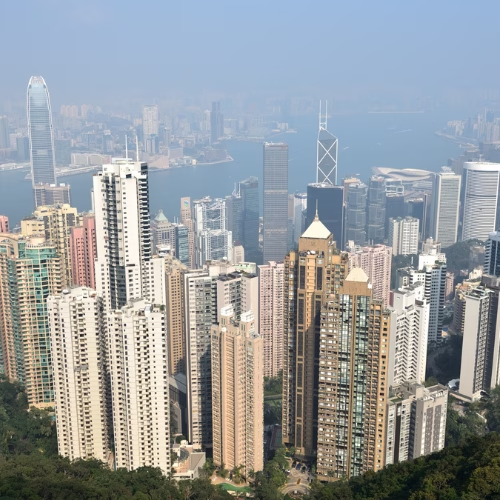
For years, Hong Kong held a unique place in the global economy. It wasn’t just another city or financial center. Instead, it was a crossroads where capital, law, and trust came together in a way you didn’t see elsewhere. Western investors relied on Hong Kong’s legal system, while Chinese companies valued their access to international capital. Governments, banks, and large multinational businesses saw it as neutral ground. Money moved easily, and contracts were trusted.
Now, that identity is changing. The shift isn’t sudden, but it goes deep.
The real change in Hong Kong isn’t just about economic numbers like office vacancies or trading volumes. It’s about who the city serves now. Hong Kong is moving away from being a global financial hub and becoming a platform more closely tied to China’s economic and strategic goals. As a result, there are fewer Western investors, more dependence on money from the mainland, and a smaller role for Hong Kong in the global financial world.
Looking back, Hong Kong’s success came from three main factors. First, its legal system was based on common law and strong judicial independence, which gave foreign investors confidence that deals would be honored and disputes settled fairly. Second, it was open to capital, with no controls, free currency conversion, and a stable monetary system. Most importantly, it was China’s main link to the outside financial world. When China’s markets were mostly closed, Hong Kong was the gateway for both international investors and Chinese companies.
Hong Kong didn’t need to reinvent the wheel or build a huge domestic market. Its main strength was acting as a go-between. The system worked because people trusted it and saw it as neutral. As long as China needed a way to connect with the world and global investors trusted Hong Kong’s rules, things ran smoothly.
But platforms like this can be fragile. They rarely fall apart overnight. Instead, confidence fades slowly when people start to doubt the city’s neutrality or uniqueness, and money begins to move elsewhere.
A few major trends have accelerated this erosion. First, Hong Kong has been gradually pulled closer into China’s political orbit and regulatory system. Officially, it’s still separate—but global investors aren’t so sure anymore. The predictability of the legal system feels less solid, more conditional. Regulatory risk gets trickier to figure out. Sometimes, just feeling uncertain is worse for investors than even knowing there are strict restrictions—it messes with long-term planning.
China’s own financial markets are also growing quickly. Beijing has invested a lot in cities like Shanghai and Shenzhen, making it easier for foreign investors to access China’s markets directly. Programs like Stock Connect and Bond Connect have made Hong Kong less unique as a gateway. As China opens more paths for foreign capital, Hong Kong loses some of its influence.
Politics also play a role. China’s relationships with Western countries have become tense, making money flows more political as well. Large international investors have to reconsider their positions and spread their risks. In this environment, Hong Kong is no longer seen as a neutral place. Instead, it looks more like an extension of China’s financial system, not a bridge.
But this isn’t about economic collapse. Instead, Hong Kong is becoming more specialized. The city now relies much more on capital, businesses, and wealthy individuals from the mainland. Most IPOs are for Chinese firms. Wealth management is mainly driven by Chinese clients. Even new financial products are shaped more by Beijing’s preferences than by global trends.
Does this mean Hong Kong is losing all relevance? Not at all. It remains vital to China. Mainland cities still can’t match Hong Kong’s banking infrastructure, global connections, or expertise. For Chinese companies and investors, Hong Kong offers something unique: international credibility and access to non-Chinese funding.
But there’s a big change: the direction of dependence has reversed. In the past, Hong Kong was important because it connected China to the world. Now, its future depends on how well it serves China’s needs.
That’s a big change. A real global financial hub has to manage many things, like different legal systems, currencies, and political interests. But if a capital platform focuses mainly on one country, it values alignment and stability over diversity. It’s hard to do both at once, at least on a large scale.
In the end, Hong Kong’s economic future will likely be more stable than its harshest critics expect, but less exciting than its past. It probably won’t regain its place as Asia’s top finance center. That role is moving to places that focus on independence, predictability, and neutrality. Still, Hong Kong will not disappear. It will keep playing an important part in a China-focused financial world.
There’s a bigger lesson here, not just about Hong Kong. It’s about how financial centers work today. Platforms like these depend on trust and credibility. When those become uncertain, the result isn’t a sudden collapse, but a slow narrowing of what the platform can offer. Hong Kong isn’t disappearing; it’s adapting. In finance, this kind of change often means the end of a global role and the start of something more focused and regional.
[ Membership ]